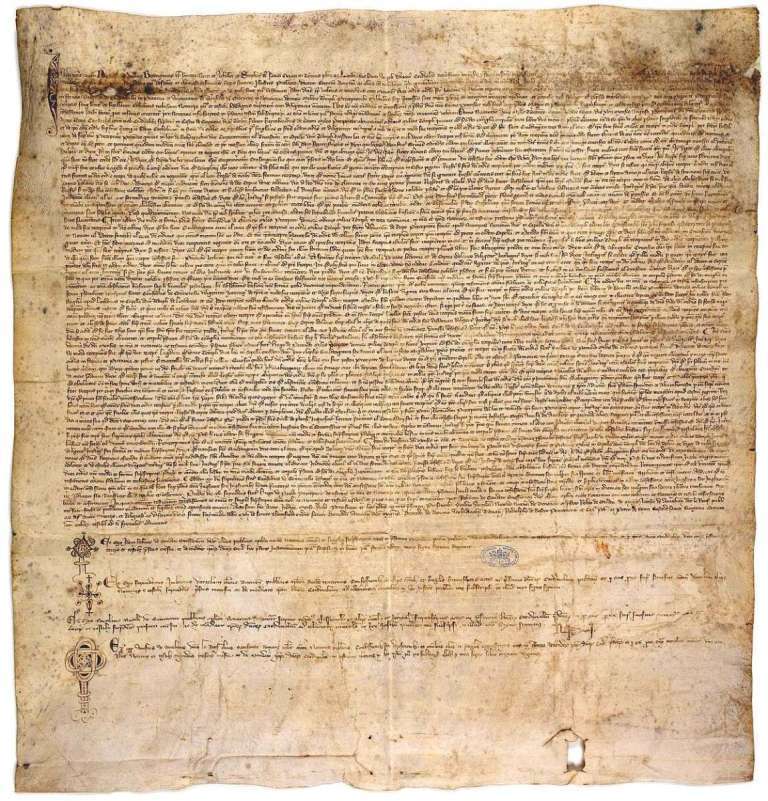
The Chinon Parchment is the record of the interrogations to which, between 17 and 20 August 1308, the leaders of the Order of the Temple were subjected in the castle of Chinon, France, after their arrest the previous year by order of King Philip IV of France. Since the accused could not be brought before the pope at Poitiers, Clement V sent three cardinal legates to Chinon to question them in person: Bérenger Frédol, cardinal priest of Saints Nereo and Achilleo; Étienne de Suisy, cardinal priest of San Ciriaco in Thermis; and Landolfo Brancacci, cardinal deacon of Sant’Angelo in Pescheria — the same men the document calls “Berengario”, “Stefano” and “Landolfo”.
The text records the interrogations of five of the Order’s highest-ranking dignitaries — Master Jacques de Molay, Raymbaud de Caron, Geoffroy de Charny, Geoffroy de Gonneville and Hugues de Pérraud — and their sacramental absolution from the charge of heresy, with their readmission to the communion of the faithful. This act preceded by several years the very different outcome of the affair: in 1312 Clement V dissolved the Order anyway, with the bull Vox in Excelso, and in 1314 Jacques de Molay himself was burned at the stake.
Preserved in the Vatican Apostolic Archive (Archivum Arcis, Arm. D 217), the document had not been lost, but remained for centuries little known and poorly catalogued, until the palaeographer Barbara Frale identified it in September 2001. Frale published her study in the Journal of Medieval History in 2004; in 2007 a limited facsimile edition was published under the title Processus contra Templarios.
The text of the document
Chinon, 17–20 August 1308
In the name of God, Amen. We, by divine mercy Berengario, of the title of Saints Nereo and Achilleo, and Stefano, of the title of San Ciriaco in Termis, cardinal priests, and Landolfo, cardinal deacon of the title of Sant’Angelo, make known to all who shall see the present public document the following: whereas recently our most holy father and lord Clement, by divine providence supreme pontiff of the most holy and universal Church of Rome, on account of what was reported by public rumour and by the fervent denunciation of the illustrious king of the Franks and of prelates, dukes, counts, barons and other nobles and non-nobles of the same kingdom of France, caused an inquiry to be opened against certain brothers, priests, knights, preceptors and sergeants of the Order of the Militia of the Temple concerning those matters that touch both the brothers of the Order and the Catholic faith and the state of the Order itself, and on account of which matters they have been publicly defamed, the same pontiff, wishing and intending to know the pure, full and complete truth about the high dignitaries of the said Order, that is, brother Jacques de Molay, grand master of the whole Order of the Templars, and brothers Raymbaud de Caron, preceptor of Outremer, and the preceptors of the Templar houses Hugues de Pérraud in France, Geoffroy de Gonneville in Aquitaine and Poitou, Goeffroy de Charny in Normandy, ordered and charged us, by a special mandate given expressly by the oracle of his living voice, that, accompanied by public notaries and trustworthy witnesses, we should carefully seek the truth concerning the grand master and the other preceptors named above, questioning them strictly one by one. […]
In the year one thousand three hundred and eight from the birth of the Lord, in the sixth indiction, on the seventeenth day of the month of August and in the third year of the pontificate of our lord Pope Clement V, in the castle of Chinon, diocese of Tours, brother Raymbaud de Caron, knight and preceptor of Outremer of the Order of the Templars, appearing before us, the cardinals aforesaid, swore on the holy gospels of God, touching the Book, to tell the pure and full truth […] he said that it was indeed about forty-three years since he became a knight, and that he was received into the Temple by brother Roncelin de Fos […] in the chapel of the Templar house of that place. And on that occasion the preceptor told him nothing but good; […] but after the said ceremony of reception a certain brother sergeant came […] and led him aside, carrying a small cross under his mantle; […]. And that brother said to him: “It is fitting that you deny this.” And the deponent, not believing that he was sinning, said: “And I deny it.” […] He said moreover that the denial he made he had made not with conviction, but in words. […] Questioned then on the vice of sodomy, he said that he had never practised it, either actively or passively, nor had he ever heard it said that the Templars practised that vice, except for three of them alone, who, for that vice, had been condemned to life imprisonment in the Castle of Chateau-Pelerin. […] Questioned concerning the spitting on the cross and the idol in the shape of a head, he said he knew nothing about it, adding that he had never heard of this head until he heard it said by our lord Pope Clement in the year just past. Questioned about the kiss, he said that brother Rossolino, when he had received him as a brother, had kissed him on the mouth; of other kisses he said he knew nothing. […] And finally the same brother Raymbaud, kneeling and with joined hands, asked before us for pardon and mercy for the facts revealed; and since brother Raymbaud himself was asking for these things, he abjured into our hands what had now been revealed and every other heresy, and a second time, touching the Book, swore on the holy Gospels of God that he would himself obey the precepts of the Church and would hold, believe and observe the Catholic faith which the Holy Roman Church holds, observes, preaches and teaches, and commands to be observed by others, and that he would live and die as a faithful Christian. After this oath we cardinals, by virtue of the authority specially granted to us by the pope in this place, imparted to the same brother Raymbaud, who humbly asked for it, the benefit of absolution from the sentence of excommunication into which, for the things previously revealed, he had fallen, readmitting him to the unity of the Church and restoring him to the communion of the faithful and to the ecclesiastical sacraments. […]
Brother Geoffroy de Charny, knight, preceptor of the houses of the Temple throughout Normandy, swore in a similar manner on the holy gospels of God, touching the book; carefully questioned about the manner of his entry into the Order, he said that it was about forty years since he was received into the Militia of the Temple by brother Amaury de la Roche, preceptor of France, at Étampes, in the diocese of Sens, in the chapel of the Templar house of that place […] the brother who had received him drew him inside the chapel itself and showed him a cross on which there was the image of Christ: and told him not to believe in that, indeed to deny it. And then, by his order, he denied it in words but without conviction. He said also that at the moment of his reception he had kissed that brother on the mouth, on the chest, and on the garment, as a sign of respect. […] Carefully questioned about the spitting on the cross, the kisses, the vice of sodomy and the idol in the shape of a head, he said he knew nothing about them.
Questioned, he said moreover that he believed that the other brothers are received into the order in the manner in which he himself was received; […] After this we cardinals, according to the manner and forms written above, considered that to the same brother Geoffroy, who was abjuring into our hands what had just been revealed and every other heresy, and who swore on the holy Gospels of God, humbly requesting also the benefit of absolution according to the forms of the Church, [it should be granted], gathering him into the unity of the Church and restoring him to the communion of the faithful and to the ecclesiastical sacraments.
[…] brother Geoffroy de Gonneville […] said that it was about twenty-eight years since he was received as a brother into the Order of the Templars by Robert de Tourville, knight and preceptor of the Templar houses in England, near London, in the chapel of the Templar house of that city. […] he told him that it was necessary for him to deny the image of the one who was depicted there; and since the novice did not wish to do so, the preceptor insisted strongly that he do it. […] And he said yes and promised that, if he were questioned by any of the brethren, he would declare that he had made the denial; therefore, according to what he told us, he denied nothing else. The Templar who received him also told him that it was necessary to spit on the cross shown before; and since he did not wish to do it, the Templar placed his hand on the cross and said to him: “Spit at least on my hand!”. […] Carefully questioned about the vice of sodomy, the idol in the shape of a head, the kisses and other matters on which the Templars are defamed, he said he knew nothing about them. […]
After this we cardinals, according to the manner and forms written above, considered that to the same brother Geoffroy de Gonneville, who was abjuring into our hands what had now been revealed and every other heresy and who swore on the holy Gospels of God, humbly requesting also the benefit of absolution for these facts, the benefit of absolution should be imparted according to the forms of the Church
Readmitting him to the unity of the Church and restoring him to the communion of the faithful and to the ecclesiastical sacraments. […] Hugues de Perraud, knight, preceptor of the houses of the Temple in France, touching the Book, swore on the holy Gospels of God in the manner and form aforesaid. […] he said that he had been received in Lyon, in the Templar house of that city, in the chapel of the same house, some forty-six years ago, more or less, on the feast of the Magdalene last past; and he was received as a brother of the Order by brother Hubert de Perraud, Templar knight and his paternal uncle, visitor of the houses of the Order in France and in Poitou.
The latter placed the mantle of the order on his neck; this done, another brother named Giovanni, who was later preceptor of La Muce, took him aside in the chapel, and showing him a certain cross on which the image of the crucifix was painted, ordered him to deny the image of the one who was represented there: he, according to what he told us, resisted as much as he could. Nevertheless in the end, terrified by the intimidations and threats of that brother Giovanni, he denied the painted image, but only once. However, although the said brother Giovanni had ordered him again and again to spit on the aforesaid cross, he would not do it. Questioned whether he had kissed the Templar who had received him, he said yes, but only on the mouth. Questioned about the vice of sodomy, he said that it was never imposed on him and that he never committed it. […] Questioned why he had ever done it and why he grieved over it, since he did it without intention, he answered that this was what the statutes, that is the customs of the Order, prescribed, and that he had always hoped that this error would be removed. Questioned whether or not he knew if all the brothers of the order are received in the way in which he himself received others, he said that he did not know it for certain, except for himself and for those whom he had personally received, since the Templars are received into the Order according to a procedure so secret that nothing can be known, except through those who are present at the ceremony of entry. […] Questioned about the idol in the shape of a head, which is said to be adored by the Templars, he said that he saw it, shown to him at Montpellier by brother Pierre Allemandin, preceptor of that place; and that head remained with brother Pierre. […]
Questioned about what age he was when he was received into the order, he said that he heard from his mother that he was eighteen. […] After this we cardinals, according to the manner and forms written above, considered that to the same brother Hugues, who was abjuring into our hands what had now been revealed and every other heresy and who swore on the holy Gospels of God, humbly requesting also the benefit of absolution for these facts, the benefit of absolution should be imparted according to the forms of the Church, readmitting him to the unity of the Church and restoring him to the communion of the faithful and to the ecclesiastical sacraments. […] brother Jaques de Molay, knight and grand master of the Order of the Temple, having appeared in person, after he had sworn, carefully questioned on the form and manner reported above, said that about forty-two years had passed since, at Beune, in the diocese of Autun, he was received as a brother of the Order, by the Templar knight Hubert de Perraud, then visitor of France and Poitou, in the chapel of the house of that place.
And concerning the manner of his entry into the order, he said that the one who had received him, before fastening his mantle, showed him a certain cross, told him to deny God whose image was painted on the cross itself and to spit on it: which he did; and yet he did not spit on the cross, but on the ground, according to what he said. He said moreover that he made that denial in words, without intention. Carefully questioned about the vice of sodomy, the idol in the shape of a head and immoral kisses, he said he knew nothing about them. […] We cardinals, according to the manner and forms described above, considered that to the same brother Jacques, grand master of the order, who was abjuring into our hands what had now been revealed and every other heresy and who swore on the holy Gospels of God, humbly requesting also the benefit of absolution according to the forms of the Church, [it should be granted], gathering him into the unity of the Church and restoring him to the communion of the faithful and to the ecclesiastical sacraments. […]
These things took place in the year, the indiction, the month, the days, the pontificate and the place recalled above, in our presence, with the following present: the public notaries by apostolic authority Umberto Vercellani, Nicolò Nicolai of Benevento, the aforementioned Robert de Condet and master Amise de Orleans called le Ratif, and the witnesses specially summoned for this purpose: the religious brother Raimondo, abbot of the monastery of San Teoffredo of the order of St. Benedict in the diocese of Annecy, and the prudent lords Bernando da Boiano, archdeacon of Troia, Raoul de Boset, penitentiary and canon of Paris, and Pierre de Soire, custodian of the church of Saint-Gaucéry of Cambresis.
Notarial Seal Robert de Condet
Notarial Seal Umberto Vercellani
Notarial Seal Nicola di Benevento
Notarial Seal Amise de Orleans called le Ratif
Cardinal Berengario of the title of Saints Nereo and Achilleo
Cardinal Stefano of the title of San Ciriaco in Termis
Cardinal Landolfo, deacon, of the title of Sant’Angelo
[source: Vatican Apostolic Archive, Archivum Arcis, Arm. D 217]


