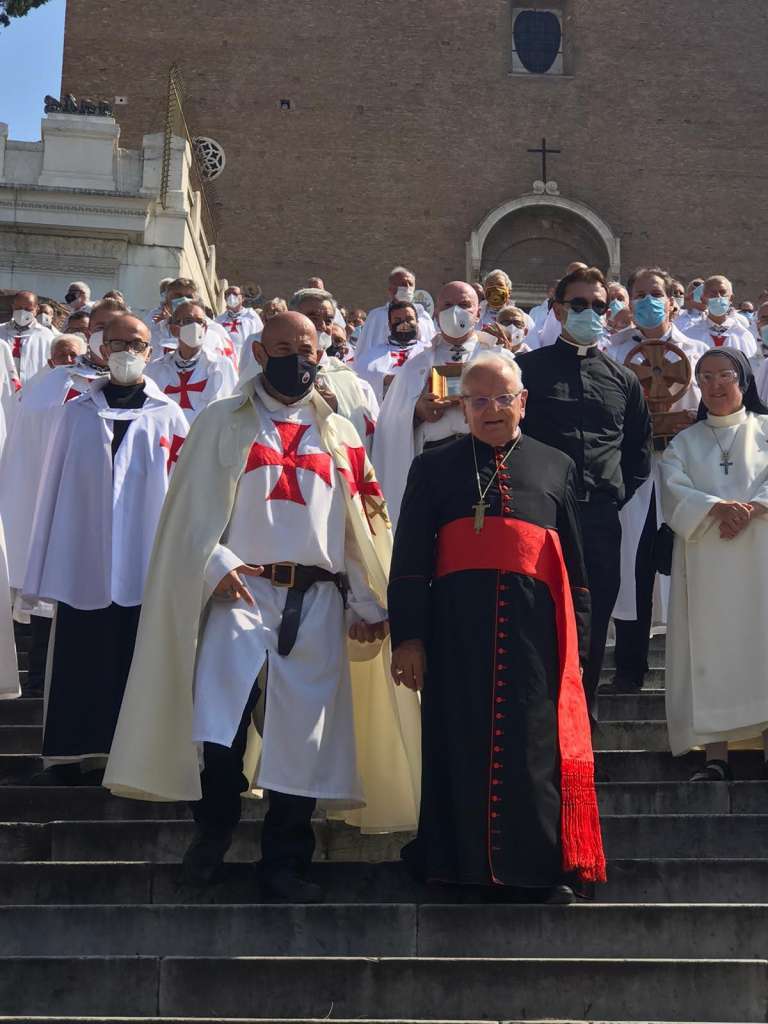
I often wonder what Rome must have been like in the 12th century. Surely, it didn’t have the kind of traffic we encounter today under normal circumstances.
This thought came to me as we crossed the Eternal City, usually chaotic, overwhelmed by traffic and the general bustle, amplified by countless tourists and pilgrims.
Yes, even this year, our Silent Walk for the Faith, which we have organized for five years, was able to take place. Despite closures, restrictions, government decrees, and various obstacles, we were there—almost alone, as pilgrims in one of the cities that, along with Jerusalem and Santiago de Compostela, has always been a destination for Christian pilgrimages.
We are very accustomed to our own silence, respectful of the sacred act of carrying relics of the Saints through the streets—relics that are increasingly entrusted to us—but not to the external murmurings of people who ask countless questions about who we are and why we are there. This year, even this murmur, unfortunately, became a victim of the virus.
Walking through the city, I felt as though I were experiencing medieval Rome: different in appearance, but immense in spirituality. This year, the city allowed itself to be heard and felt, even in its sad but captivating silence. The overwhelming “melody” of the historic center—and even the modern nightlife districts—was silence itself, surreal and sovereign.
We began from one of the most visited squares in the world, Piazza Pio X, adjacent to St. Peter’s Square, with the Basilica of St. Peter as the backdrop—empty, like much of the city.
Unlike in previous years, we did not walk along Via di Porta Angelica. Despite various permissions from the Italian State and the Vatican Governorate, the only concession we made to the virus was to slightly alter our route.
Viruses, of course, find a way wherever they can take root, and this time, unexpectedly, space was granted by a religious official—fearful of contagion—who rigidly and, in my view, inexplicably tried to hinder pilgrims coming from all over Italy, faithful Christians determined to be witnesses of our Faith. This behavior, in my humble opinion, goes against every aspect of the Catholic, Apostolic, Roman Ministry, and especially against the will of Pope Francis, who repeatedly calls on the faithful to repopulate churches that are increasingly empty. And then we wonder why!
Jesus Christ’s first message to the earliest Christians was: “Do not be afraid!”
This, indeed, is perplexing, yet it reflects the Church we live in today: at times fearful, made up of timid men who, as a result, are insensitive to the courage of us Christians—a courage they themselves should transmit, fully aware that God is Love, protecting those who pray sincerely.
History repeats itself; one only needs to recall the Eucharistic miracles and why God Himself had to reveal Himself to Church leaders who had little or no faith in their own ministry.
On the other hand, our courage is always supported by the state authorities, particularly the Italian Police, who provided the necessary personnel to ensure the Silent Walk could be carried out safely. They accompanied us for all seven kilometers of the route, moving alongside us through an empty city in need of the prayers and hope we brought—a hope for which many thanked us.
For the first time, we attended Holy Mass at the Church of Saint Alphonsus de Liguori, home of the Alfonsian Academy and the Congregation of the Most Holy Redeemer.
The Redemptorist Fathers were honored, as Rector Father Gianni Congiu explained in his opening remarks, to host us in their church and celebrate the Eucharist with us and the regular faithful. The Church, the house of God and His chosen people, should always be filled (with social distancing, of course) with pilgrims coming to meet Christ, their King and Savior. And when, if not during such dark times for humanity, do we most need to encounter God and be saved by Him?
The Eucharistic Rite was celebrated by Father Paolo Alberico Giammaria, a Cistercian monk from Valvisciolo Abbey and one of our spiritual guides. We then welcomed Father Wagner Gonçalves de Souza Lima, a Brazilian priest, who shared his experiences and will continue to serve alongside the Catholic Templars of Italy, bringing this witness to his fellow Brazilians. He was deeply impressed by the principles and actions our Order strives to uphold against all obstacles.
On Sunday, September 20, concluding our spiritual retreat, we walked through the Imperial Forums, starting from the Colosseum. For the first time in centuries, we honored the ancient Christian martyrs with silent prayers and witness.
Still in silence and order, we reached the Basilica of Santa Maria in Ara Coeli, a fixed point of our pilgrimage, where we attended Holy Mass presided over by His Eminence Cardinal Francesco Monterisi. He was so moved by the faith and participation he witnessed that he became one of our Ministers Templi, our spiritual guide and Patron. This gives hope for a future that finally seems to glimpse a ray of light after many obstacles we have continually faced.
Even this year, so particular, difficult, and complicated—both organizationally and practically—our determination prevailed over forces that sought to obstruct us and silence our witness of Faith in Christ and ancient, traditional values, which we are committed to transmitting through our actions and presence, walking through the streets where pilgrims and even the distant faithful gather.
Now, more than ever, there is a need for us Templars—brothers, for our determination, kindness, humility, and service. And if any of this is ridiculed or rejected, patience. As Matthew writes: “If anyone will not receive you or listen to your words, leave that place and shake the dust from your feet as a testimony against them.”
Non Nobis Domine Non Nobis Sed Nomini Tuo Da Gloriam
Fra’ Daniele Borderi


